
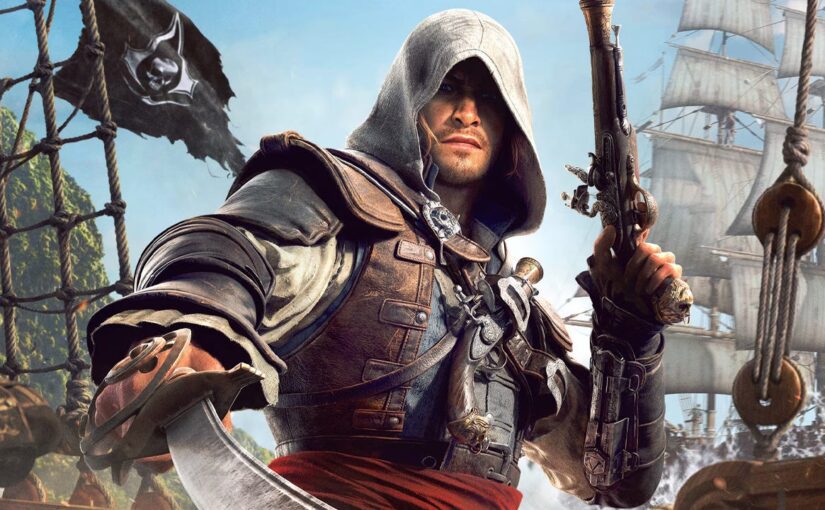


Whenever a new Assassin’s Creed comes around, the conversation inevitably loops back to the same question: “Hey, remember the one with the pirates? That one was great.” Assassin’s Creed 4: Black Flag is the last game my friends who lapsed on the series have played. It’s the one whose hero, Edward Kenway, always sits high up on “Best of” lists. It’s the one that spawned two remarkable spin-offs and inspired a whole game that is just ship combat. Black Flag was a cultural moment, and Resynced isn’t just a full remake of that juggernaut, but Ubisoft Singapore’s celebration of the original’s well earned reputation. With new graphics, revamped combat both in melee and on the high seas, and retooled exploration and stealth systems, its bigger and better in all the ways that matter.
The most obvious upgrade is in how Resynced looks. The 2013 original actually holds up surprisingly well thanks to its tropical color palette and great lighting, but Resynced is still a flex in comparison. Ubisoft’s Anvil engine is a clear step up thanks to new options like ray tracing, with 2026 textures and physics also adding depth to hair, skin, and clothes that just couldn’t be done back then – and all at a smooth 60 fps on PC. The bigger cities you’ll visit, like Havana, are bustling with people and the wilderness is dense with lush foliage. Like with last year’s Assassin’s Creed Shadows, Resynced also has some pretty remarkable wind, water, and weather effects.
Every IGN Assassin’s Creed Review
Bringing Black Flag in line with modern Assassin’s Creed design also adds some much needed modesty to the world map. Previously, your map was littered with icons marking things to find and do in distracting abundance. The more discovery-focused approach introduced in Assassin’s Creed Valhalla – where non-quest-related points of interest don’t show up until you observe them from synch points or are in direct proximity to them – helps keep the map from being overwhelming, but also encourages you to actually explore this refreshed and remixed world.
Travelling through that world is enhanced by Resynced’s updated freerunning mechanics. It may not seem too different from what you remember at a glance, but I revisited the original Black Flag just before this review, and there are a handful of modern tweaks here that make it a notably better experience. Parkour runs transition from one move to the next much more smoothly, and you can change direction far faster in case you find something in front of you that you don’t like and need a new route quickly.
A handful of tweaks make the freerunning a notably better experience.“
The routes themselves are now more boldy highlighted by white chalky paint and cloth on buildings in a way that has become more noticeable in games from the last decade, so there’s less trial and error when it comes to jumping from step to step. It has the breezy slickness of 2023’s Assassin’s Creed Mirage (without the same level of urban density to trick through), but it does also retain a little too much of the stickiness that came from AC games of the original’s era. Too often did a good running sequence come to a complete stop because the angle I hit a jump from was off by some microscopic amount, or because Edward would fling himself down one path even though I definitely needed him to leap through another.
Edward Kenway’s story is one of the most beloved in the series for good reason. It’s filled with memorable characters, consequential twists and turns, and some great writing and acting. It was unconventional for its time: a selfish pirate in pursuit of glory who has to be dragged into the conflict between Assassins and Templar kicking and screaming, and at great personal loss. 13 years later, there still aren’t many stories that break the mold in quite the same way in this series. It’s still easily a top three Assassin’s Creed adventure, and I wouldn’t put it at number three.
The story has even gotten some additional love, mostly in some extra cutscenes that expand on certain moments with characters like Blackbeard – as well as a brand new end-game chapter that lets you tie up a loose end related to a character that never saw any justice for his crimes in the original. Some quests get reworked to make them a bit more open-ended, as well. For example, it used to be that the only way to get the diving bell to search a wreck for medicine was to save up enough money to buy it from your ship vendor. Now, there’s an alternative way: steal it from a group of soldiers. Some of these adjustments won’t even stand out as new if you haven’t played the original recently, but as someone who has, changes like this really help speed up some of the chokepoints in the story’s pacing that felt more like busy work than swashbuckling.
Gone completely are the present day interludes where you would tiptoe around the Abstergo offices to try and sabotage the evil Templar corporation from within. Instead those glyphs scattered around the map from the original now contribute to various meta progression systems in the new Animus Hub project, which Ubisoft first introduced in Assassin’s Creed Shadows Finding floating glyphs in the wild to earn points and level up mostly amounts to a glorified battle pass, which isn’t my idea of fun, but Resynched does at least take an admirable step in the right direction. You can now enter special Rifts that serve up some unique platforming puzzles and act as the backdrop for a story between a voice locked in the Animus that wants to show us the “truth” and the Animus itself attempting to trap us inside forever. It doesn’t really go anywhere definitive, and it is kind of a bummer to see the present day story sort of be abandoned whole sale, but I am interested to see how this Rift idea develops in future games.
Death Marks the Spot
We take it for granted now, but it’s genuinely hard to believe that Assassin’s Creed didn’t have a dedicated crouch button in 2013, and I was there! The addition of one to Resynced really does change Black Flag’s stealth dynamics, even if some layouts and soldier patrols were adjusted to accommodate that newfound freedom. Being able to duck behind cover without having to press against it to break line of sight really helps you stay hidden while scouting ahead. You also no longer have to awkwardly sprint from stalking zone to stalking zone to stay undetected. Something as simple as crouching allows for so many more ways to remain unseen that other, more outside-the-box ways to solve problems actually get undermined, like the so-called “social stealth” of blending into crowds, hiring distracting dancers, or scattering money on the ground. I never really thought about how little I’ve used these options after Assassin’s Creed Unity (where the crouch was first introduced) even though they’ve existed in some form in almost every game since, but going back in time like this really puts this conflict of systems in stark relief.
Tools like darts and bombs and distractions like whistles are quicker and easier to access thanks to Resynced’s modern HUD and menus, and the series-standard visibility and alert meters are better at helping you stay anonymous. These quality-of-life features make Edward all the craftier, but his foes have not evolved in similar ways to meet the moment. They can still see pretty far distances, and will reliably be suspicious if you’re not making your best effort to remain hidden. In stealth sections, especially in urban areas, guards are everywhere with lots of roaming patrols that overlap their vision areas with static sentries, which makes moving around at the right time imperative. But despite all that, it can take quite a while for them to be alerted and spring into action, and the extended time they spend in that yellow “curious” state makes them very easy to manipulate.
The overhauled combat brings Black Flag confidently into the modern era.“
Some of the stealth-based activities have been updated as well, specifically the eavesdropping sequences. The old version of them, which required you to stick within the listenable zone of a pair of characters yapping about important information without being seen, had its issues. But what’s replaced them in the more recent AC games, just pressing a button once you get close enough to hear them, really dissolves any intrigue or attempt at immersion that this activity was supposed to create. The old style needed work, especially in its sometimes frustrating checkpoint placement, but I sorely miss the engagement it provided now that those sections have been replaced with the throwaway versions in Resynced.
When stealth eventually fails, its time to draw steel and brawl. To its ultimate benefit, the overhauled combat here brings Black Flag confidently into the modern era. Spamming light attack strings still makes Edward a duel-wielding dervish, but now enemies have posture bars to wear down instead of just health. Quick hits in conjunction with new heavy attack finishers – whose effects vary depending on which of the three weapon types Edward has available to him – empty these bars quickly, making most enemies vulnerable to instant ,one-button takedowns that you can chain to nearby enemies when you really get grooving. The new parry works a little like the old counter button but, instead of simply displacing enemies, it breaks posture and opens them up while also keeping Edward safe.
Even with the addition of the new blunderbuss bomber, bad guys come in fairly limited variety but often large numbers, and most are pretty good at defending basic attacks head-on. Resynced gets rid of the one-note “break defenses” button and gives Edward some tricks to overcome these turtles, like sweeping their legs and opening them up for a final coup de grâce that uses a powerful, Odyssey-inspired kick to knock people into walls or off of ledges. Quick selecting your tools also lets you break a combo to simply shoot a guy directly in the face or rope dart a man from across the room, Mortal Kombat-style. Against tougher enemies in bigger groups (or when you take advantage of the new difficulty settings to increase the challenge a bit), this all really comes together to create relatively simple but satisfying combat where each of your options feels useful and necessary for success. I didn’t even miss the now-removed option to take weapons from enemies to use against them.
On normal difficulty, the general back and forth of battle feels similar between both games, but it does sometimes feel like parries can trivialize combat when enemies are in small groups. You can just wait for them to act, swat their wet noodle attack away, and send them to great below with little effort – and while this was also true of the original, doing the deed took more than two button presses (though not many more). Combat is also far less cinematic overall. All of the twisting and twirling around enemies that Edward did in the original Black Flag, including the very cool chain finishers, hid a lot of these pretty basic interactions, and those are now completely gone. So I do think it was ultimately a trade up for Resynched to have a more legible and interactive system, but it did come at a cost.
Jarrett Green’s Top 10 Assassin’s Creed Games
See All
As 1700’s-era piracy demands, sometimes you and 30 of your friends need to get on a brig and use cannons in order to settle some differences with the local imperial naval presence. Black Flag’s evolution of the sailing systems introduced in Assassin’s Creed 3 was always the stand out part of this experience, and its back and better in every way in Resynced. Each of the four main ways to attack – broadside cannons, long-ranged mortars, sail-ripping chain shot, and explosive fire barrels – now have secondary firing options unlockable through quest or side mission rewards. I got a lot of use out of the Heated Shots option for the broadsides, which has a shorter range but is absolutely devastating in comparison to the regular round shot thanks to its high chance to leave an exploitable weak point that can be shot again with your swivel guns to pile on even more damage. Swivel guns themselves act more like the ones from Assassin’s Creed Rogue, where you hold to aim your crosshairs over the target and they automatically shoot as opposed to the more sluggish QTE prompts of the old style.
Ships can get some brand new abilities now too thanks to some new naval officers that can be recruited to your crew. These abilities are very strong, like the shipwright’s Perfect Brace that allows you to block extra damage if you press the brace button right when an attack hits your ship rather than just holding it down – and with high enough hull armor, you might negate it completely. This was a vital addition that really helped me survive some of the hairier encounters towards the middle and end of the campaign without having to grind money to simply overlevel my way out of trouble. Combined with the man-at-arms’ Dashing Ram ability and the weapon master’s Double Shot, Edward and his crew have never been more deadly. Sailing around the Caribbean looking for the biggest ships I could find to test my luck was my go-to activity when I needed a fun break in between story beats.
The new enemy behavior and weather effects were most apparent out on the seas as well. Spanish, English, and pirate ships would fight one another on a regular basis, allying with each other in different configurations based on the situation. And for every time I saw two factions of ships trading fire, I’d see a group of ships flying the same flag traveling passively through the ocean just as often. Weather can get gnarly while sailing as well, especially with new hazards like lightning strikes throwing your path in disarray.