


Christopher Nolan has discussed his approach to building the world of The Odyssey, insisting his goal was to make it feel “very fresh for modern audiences” and “do away” with the “cultural prejudices” we have when we think about he ancient world.
In an interview with Channel 4’s Krishnan Guru-Murthy, Nolan explained why people tend to think historical epics have to sound so formal, and why he went the complete opposite direction for The Odyssey.
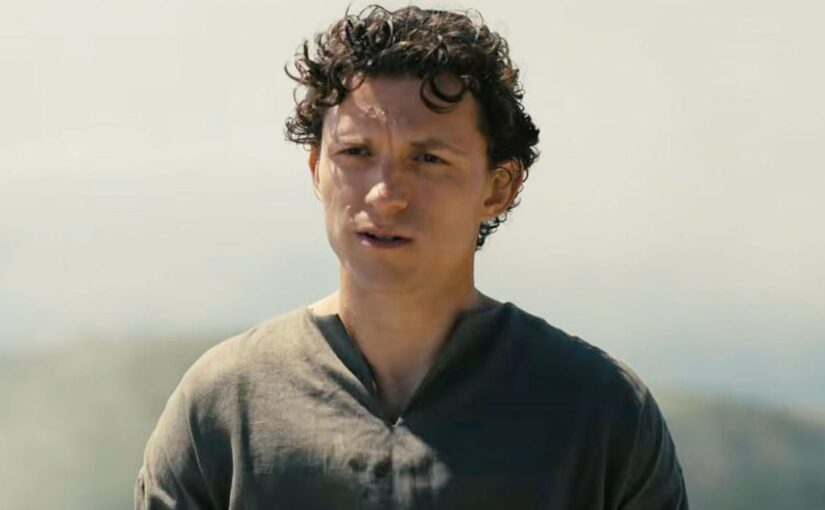
In The Odyssey, Spider-Man star Tom Holland plays Telemachus, son of Matt Damon’s Odysseus. In the movie Telemachus tells Robert Pattinson’s villainous Antinous, “my dad is coming home.” That line of dialogue has become a lightning rod for online debate about The Odyssey and historical accuracy. This is an adaptation of Homer’s ancient Greek epic the Odyssey, and, some say, “my dad is coming home” perhaps doesn’t fit the setting. Countering that is the fact that The Odyssey is a “mythic action epic,” one that features a giant, one-eyed monster and enchanting bird-women whose irresistible songs lure sailors to their deaths on rocky shores, among other mythical creatures, so historical accuracy isn’t perhaps the point.
The Odyssey Cast and Characters: Who’s Who in the Christopher Nolan Film
In the interview, Guru-Murthy asked about Holland’s “dad” line, and the actor had a succinct response. “Because I wouldn’t have even said ‘Father’ back in the day, would I? I would have been Greek, so it’s no less correct,” he replied.
Nolan himself expanded on this, saying that people have “cultural prejudice” around the ancient world and tend to elevate it “because it’s old.” His intention with The Odyssey was to go in a different direction, “do away with some of those assumptions that aren’t based on anything logical,” and present “a consistent and accessible world around that that feels vital and credible and exciting to be in.”
“When you look at this world, when you look at the ancient world, people tend to view it in weird ways. There’s a lot of cultural prejudice. There’s a lot of elevating it because it’s old,” Nolan said.
“When you go to the poem, what you find is something that is really earthy and grounded and accessible. So for me, in building the world of the film, when I talked to all the actors about it, I said, I just want to centre it on that and make it feel very fresh for modern audiences, and do away with some of those assumptions that aren’t based on anything logical. They’re just, as I say, cultural prejudices or things over time..
“Stylistically, aesthetically, people tend to look back to the Romantic era and art, a lot of the paintings where people aren’t wearing very much. They’ve got a little bedsheet wrapped around them or whatever it is, and a lot of classical architecture even though that wasn’t the architecture of the Mycenaean period.
“We went back to what’s in the archeology, what does that tell us? And what gaps does that leave? What do we know about Homer’s time? How were things portrayed in the earliest possible portrayals of that? And looking at how do you create a consistent and accessible world around that that feels vital and credible and exciting to be in.”
In a recent interview with the Los Angeles Times, Nolan said he wanted to find “language that has emotional not intellectual meaning to people,” and so went for contemporary dialogue rather than artificially elevated speech. But he admitted he might have called it wrong. “I was maybe being naïve, it might bite me on the ass,” he said, “but I wanted an earthy narrative. To me it was a no-brainer.”
Nolan went on to insist that his casting choices were, similarly, about putting contemporary faces on characters from ancient myth. For example, Lupita Nyong’o plays Helen of Troy, Jon Bernthal plays Sparta’s King Menelaus, and Zendaya plays the goddess Athena. “These are mythological figures, iconic in some ways,” Nolan said. “I wanted to cast it big, get the finest bunch of actors,” because, as the LA Times put it, their familiar faces would help a modern audience feel at home in an ancient story.
Nolan defended his approach with The Odyssey back in May, too, when he responded to complaints about historical accuracy after some said Agamemnon’s armor looks like Batman’s. In December last year, when the debut trailer for The Odyssey revealed Agamemnon’s imposing, all black suit, some joked that it looked out of place. As one commenter said at the time: “Had no idea Ancient Greeks used Batman helmets and sailed in Viking ships. Seriously, how hard is it to look at the picture of what the real thing looked like?”
In a profile in Time magazine, Nolan defended his movie from such complaints. The Odyssey is set at the end of the Bronze Age (a period of societal collapse in the Mediterranean basin during the late 13th to early 12th century BC), and Nolan said our knowledge of the era is based on “very fragmentary archeological records.” He then insisted Agamemnon’s armor as it appears in the movie is feasible.
“There are Mycenaean daggers that are blackened bronze,” Nolan said. “The theory is they probably could have blackened bronze in those days. You take bronze, you add more gold and silver to it and then use sulfur. With Agamemnon, Ellen [Mirojnick], our costume designer, is trying to communicate how elevated he is relative to everyone else. You do that through materials that would be very expensive.”
Nolan then said Homeric characters were initially depicted “in the manner of people living in Homer’s time,” roughly 400 to 500 years after the collapse of the Late Bronze Age, “so there’s a pretty strong case there for portraying things that way because that’s the way the first audience received the story.”
Nolan also noted parallels between The Odyssey and his 2014 movie, Interstellar, which used real-world science to predict and depict interactions with black holes. Some complained about the physics at play in Interstellar, and Nolan sounded philosophical about the historical accuracy complaints on The Odyssey, over a decade later.
“For Interstellar, you’re looking at, ‘What is the best speculation of the future?’ When you’re looking at the ancient past, it’s actually the same thing. ‘What is the best speculation and how can I use that to create a world?’” he said.
“Hopefully they’ll enjoy the film, even if they don’t agree with everything. We had a lot of scientists complain about Interstellar. But you just don’t want people to think that you took it on frivolously.”
The Odyssey hits theaters July 17, 2026.
Wesley is Director, News at IGN. Find him on Twitter at @wyp100. You can reach Wesley at wesley_yinpoole@ign.com or confidentially at wyp100@proton.me.