
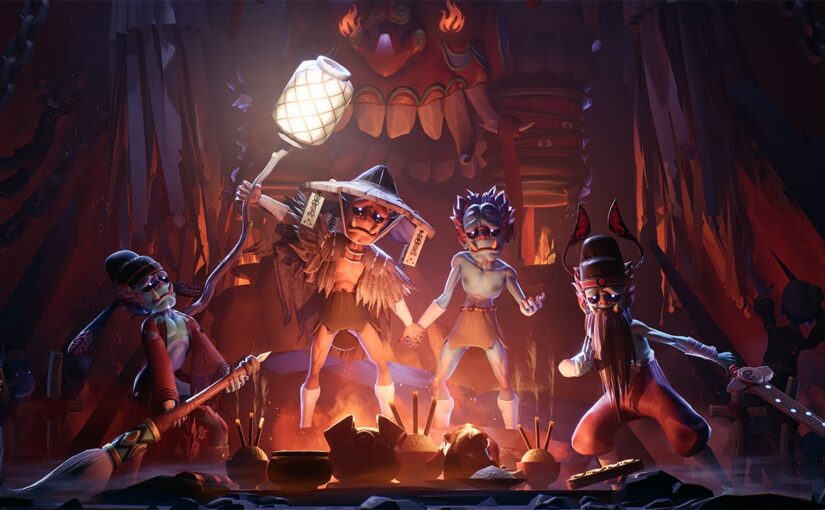


In Hundred Nights: DIFU, management life is hell. No, not because you have to maintain medical wings and cure strange illnesses like in Two Point Hospital, or painstakingly curate artifacts and herd guests around like Two Point Museum. I’m talking literal hell, because Hundred Nights: DIFU casts you in the role of the chief executive officer of the underworld, processing the lost souls who descend from the mortal coil and must face judgement for their sins before they can be reborn back into the earth realm. At a recent BiliBili Game First Look event in Shanghai I got hands-on with the opening tutorial stages of this cheeky, Two Point-inspired spin on Chinese mythology, and enjoyed the opportunity to fashion my own personal hellscape and punish each soul who passed through its flaming entry gates.
If, like me, you’re somewhat uninformed when it comes to Eastern religions, DIFU is effectively the Chinese equivalent to the Christian concept of purgatory. It’s believed to be a subterranean maze made up of various levels and chambers, and that’s exactly the landscape I found myself sculpting during the opening 30 minutes of its singleplayer campaign.
BiliBili Game First Look Event Photos
Before I could begin manipulating the mounds of my little slice of hell, though, I needed to start with the basics. With an underworld assistant named Ox Head to guide me, and a handful of souls staggering around under the weight of their own bad karma, I first had to construct a facility for them to be judged in. Hundred Nights: DIFU gives you quick access to menus for constructing facilities and staffing them with a host of hellbound helpers, with each coming at a cost to your main currency known as D-Cash.
After building a fenced-off area and dropping in a judge’s desk for my newly hired Soulkeeper to sit at, as well as a zen pad for the wandering souls to sink to their knees upon and beg for redemption, I soon got to the most entertaining part of being the overseer of the underworld: the punishment. With some freshly-judged souls forming an orderly queue, I quickly cobbled together a copper slapper. A copper slapper might sound like the term given to a British person accused of assaulting a policeman, but in Hundred Nights: DIFU its actually a sort of totem pole that the souls are pinned to while they’re slapped around and occasionally tickled by a disembodied demon hand until their karma has been cleansed and converted into D-Cash.
From there, the freshly cleansed souls must take a sip of Meng Po’s soup to force them to forget their previous life and let go of all prior obsessions before they can be reborn, which led me to build a bubbling soup stand and staff it with a chef. And to keep the assembly line going, I soon added the gates of hell to welcome the fresh meat, and a rebirth stop to send them on their way in a bright blue beam of light once they’ve paid their penance. The more souls you convert from sinners to new-beginners, the more your management rank increases and the more facilities you can add to the fiery depths of your netherrealm.
Hundred Nights: DIFU – Preview Screens
Evidently the underworld is a bit like Disneyworld, in the sense that the lines can be long and the people stuck in them can get pretty agitated. Thus occasionally the souls waiting to be slapped and tickled developed grudges and started attacking the facilities. Broken facilities breeds even more resentment amongst the hapless hordes, and therefore I had to quickly hire both a soul tamer to calm them down and a hellbound handyman to run repairs on my conked out copper slappers, swelling my staff numbers and further eating into my D-Cash reserves.
The only way to earn more D-Cash is by processing souls, and the best way to achieve that is by boosting the efficiency of your underworld operation by improving the decor. Yes, like an episode of Queer Eye but for dead guys, I had to pimp out my own personal purgatory with decorations like small stone lamps to guide the souls to each step of their rehabilitation, and rock statues to boost the prestige of any copper slappers in their vicinity in order to increase the D-Cash I earned per soul redeemed. Eventually I had enough demonic decor to fill beelzebub’s bachelor pad, and although it was a little cluttered it at least seemed like my little soul sanitation center was appropriately set up to meet my key performance indicators.
As it turned out my little underworld was both understaffed and underdeveloped, and my D-Cash reserves quickly plummeted into the red. Thankfully I’d piled up enough incense, which is Hundred Nights: DIFU’s second currency that you earn from each soul you successfully rebirth, to be able to start adding on additional islands using a terraforming tool. This tool allows you to manipulate the circumference and height of each island, which can be anchored together with two chained-together axes, expanding your real estate area with floating chunks of earth, mountains, and caves to pack with various soul-torturing tools to help put the hell into your hell-thy bottom line.
Evidently the underworld is a bit like Disneyworld, in the sense that the lines can be long and the people stuck in them can get pretty agitated.“
By the end of my hands-on I’d added a cold claw to freeze the bad karma out of my little soul buddies, built a ‘soulstaraunt’ because apparently those caught in limbo still need feeding, and earned a fourth promotion to being a senior executive (presumably that position comes with a window office?). I had a relaxing time shepherding around the little lost souls in my short stay with Hundred Nights: DIFU, although I must admit it was quite a lot of foreign concepts for me to process as someone not particularly familiar with Chinese mythology.
In an effort to broaden its appeal with audiences worldwide, though, it’s possible that Hundred Nights: DIFU won’t just be restricted to its roots in Chinese mythology after its release. According to the developer PixelsCove Games, while Hundred Nights: DIFU will be primarily focussed on this Eastern idea of the afterlife, it’s open to the idea of introducing the interpretations of hell from other cultures into the game via downloadable content after launch. There’s certainly a lot of fertile ground to be found in humanity’s various versions of the afterlife, whether it’s casting souls into the cold and gloomy realm of the Nordic Helheim or tossing the poor little saps into a lake of fire and brimstone in the common Christian interpretation. Theoretically Hundred Nights: DIFU could get The Simpsons onboard for some licensed content and we could potentially be forcing Homer to eat donuts for all eternity.
Those who are already well-versed in Chinese mythology will likely be pleased to hear that the finished version of Hundred Nights: DIFU is set to include story missions featuring some recognisable characters. The example given to me was Wukong, the legendary trickster god from Journey to the West that was last seen breaking sales records in Black Myth: Wukong, who will show up at some point to unleash his own brand of chaos to your carefully curated realm when you least expect it.
I’m also told that there will be a lot more variety in the animations of the souls, whether they’re wandering idle or reacting to their unique punishments. Additionally, the development team has indicated that Hundred Nights: DIFU will feature a roguelike minigame inspired by the fishing levels from Dave the Diver, which will allow the player to go on excursions to other ancient realms in search of rare artifacts that can be exhibited inside their customised underworld. Along with that, each of the soulkeepers on your staff will have their own skills to be built upon, both increasing their abilities but also their monthly salaries. Lastly, the terraforming tool will be further fleshed out, with the developer aiming for it to be similar to the PC diorama builder Tiny Glade in the way it will procedurally generate more detailed flourishes to make your hellscape easier on the eye, as opposed the fairly generic island blobs that you can construct currently.
Hundred Nights: DIFU is currently in development for both PC and consoles. It’s certainly early days for these Hundred Nights, but from this small taste it seems like it could be a cosy management sim with as much depth as the sprawling subterranean expanse it takes place in.
Tristan Ogilvie is a senior video producer at IGN’s Sydney office. He attended BiliBili Game First Look as a guest of the event organisers.