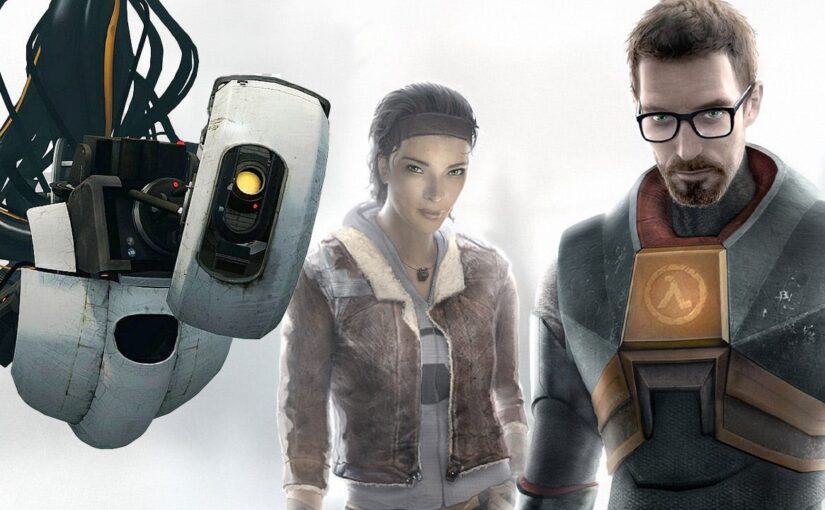

Half-Life 3 may not be here yet, or ever arrive, for that matter, but that doesn’t mean there aren’t already plenty of incredible games from developer Valve Corporation to play. And now with the brand new Steam Machine console to experience them on, what better time to get stuck in? The custodian of Steam may not be anywhere near as prolific as it once was when it comes to actually making games, but it still has a ridiculously strong list to pick from – some of which are daily destinations for hundreds of thousands of players. But which are the best? Well, that’s exactly what we’ve tried to decide here as we take in the importance, endurance over time, and innovation each of these games has brought to the table over the past three decades. Here are the 10 best Valve games to play right now.
Steam Machine – Hands On Photos
10. Left 4 Dead
A blood-soaked homage to zombie action cinema as much as it is a revolutionary landmark piece of co-op game design, Left 4 Dead was unlike anything else when it arrived in 2008. Across its multiple four-player modes, tight gunplay and edge-of-your-seat encounter design, it dished up ultra-satisfying combat that left the undead decapitated, but bathed in a stunning sheen of filmic lighting and grain effects that George A Romero himself would be proud of. It’s a perfect example of the blend of artistry and technology that has driven some of the studio’s most valued creations.
Valve is a developer known for its innovation, and nowhere in Left 4 Dead is this seen more clearly than in its campaign “Director” — an AI that oversees the player experience, tailoring the flow of combat and the challenges it presents. It’s this dynamic overlord that makes this zombie horde shooter so compelling, twisting each run against Boomers, Hunters, and the much-feared, screeching, Witches into ever-surprising gauntlets of survival that were hard to tear ourselves away from, even when knowing the horrors that lurked within them.
9. Dota 2
The story of Dota 2’s development is a curious one, and a tale too long for the mere couple of paragraphs I have here. Essentially a sequel to a fan-made mod of Blizzard Entertainment’s Warcraft 3 called Defence of the Ancients, Dota 2 was announced following designer IceFrog’s hiring by Valve to create a MOBA of their own after Blizzard passed on his services. With the resources of Gabe Newell’s empire fuelling it, a multiplayer online battle arena giant was born, as deep, intricate combat systems overlapped to form the basis of one of the biggest eSports games of all time.
It was a brave move back in 2010 to announce a direct competitor to the phenomenon that was League of Legends, but that gamble paid off almost immediately, as it topped Steam’s concurrent player numbers with 330,000 users a whole month before its official release. Over fifteen years later, Dota 2 has more than proved its worth in the MOBA space and is still played fervently to this day by as passionate a fanbase as you’ll see anywhere in games.
8. Left 4 Dead 2
Left 4 Dead 2 built on the already brilliant foundations of its predecessor, improving its co-op undead action in pretty much every way to continue Valve’s long history of sensational sequels. Across its five campaigns, new types of infected were introduced, each controlled and sent to hunt you by the improved AI Director 2.0, which now had power over the geography of the levels themselves, creating deadly, shifting labyrinths that tested the most hardened of Left 4 Dead enthusiasts.
Upping the ante in every facet, boycotts and concerns over the graphic nature of its violence couldn’t stop Left 4 Dead 2 as it far outsold its predecessor, taking both PC and Xbox 360 sales charts by storm. Many imitators would follow over the years — Warhammer: Vermintide, Back 4 Blood, and Deep Rock Galactic, to name a few — but none could ever truly rebottle the magic created within Valve’s walls with the Left 4 Dead series.
Deadlock Early Access
A little break from the list here to say we’re only allowing games that Valve has fully released, hence why the hugely popular Deadlock won’t be appearing. Remember: it barely has a Steam store page, never mind a “buy” button. That’s not to say that it isn’t already a fantastic game, though, with its combination of third-person shooter and MOBA mechanics proving a big hit on Steam during its multi-year, highly exclusive, invite-only early access period. Essentially taking what the studio learned from the successes of both Team Fortress 2 and Dota 2, Deadlock offers fantastic 6v6 combat that wouldn’t be out of place in a hero shooter, but transplants it into the corridor-like lane structure more commonly seen in online battle arenas. With 32 characters already available on its roster, and more yet being teased, it’s come a long way since its initial beginnings in the summer of 2024, with updates continuing to gear it up for that eventual full launch. If Valve’s history with bringing in enormous numbers of concurrent players into its online multiplayer games is anything to go by, it’s set to be yet another Steam sensation when that day comes.
7. Team Fortress 2
Although its origins can be traced all the way back to a 1996 Quake mod, 2007’s Team Fortress 2 can largely be credited with the mainstream popularity of the hero shooter. Combining two of Valve’s greatest loves — turning mods into sequels and innovating new subgenres — one of the first “games as service” focused on tried and tested multiplayer shooter modes such as king of the hill and capture the flag, but injected them with a set of uniquely skilled and armed characters that made squadmates completely rethink how to approach each match.
In development for almost a decade, Team Fortress 2 made the successful transition from military shooter vaporware to Source engine success upon Valve’s acquisition of the project, thus turning it into a multiplayer mainstay for years on PC and console thanks to its inclusion in the best-selling Orange Box. It was that Valve coating of character and humour that really made TF2 stand out from the crowd, though, making each member of its roster a joy to play with and listen to. Its success would be eclipsed by the likes of Overwatch in the years after, but its legacy lives on as a pioneer of a subgenre that burned brightly in the 2010s.
6. Counter-Strike: Global Offensive
Counter-Strike’s loop of objective-based, high-stakes battle is a simple concept for a shooter, but one that demands mastery. The pursuit of pinpoint accurate headshots and practically precognitive reactions has kept the series locked in as one of the most-played multiplayer games for the best part of two decades. Global Offensive is arguably the height of its success, despite initially arriving as an uncertain successor to the beloved CS: Source, drawing in near-unprecedented player numbers on Steam, as well as nurturing one of the biggest eSports scenes ever built.
Most of its nine modes tweak the 5v5, terrorist vs. counter terrorist formula to some extent, but none are more enduring than the pulsating plant and bomb defusal action of Competitive, which has gone on to inspire many other shooters since. Without CS: GO, there would be no Rainbow Six Siege, and there would be no Valorant. Although it’s since been replaced by the more advanced Counter-Strike 2, and its reputation has occasionally been tarnished by gambling scandals and its role in normalising microtransactions via weapon skins, many would argue that nothing has quite captured the magic of Global Offensive’s very best days. Yet another example of Valve seeking out a shooter subgenre to make their own, CS: GO remains one of the studio’s greatest achievements.
5. Portal
In 2008, Portal took Half-Life 2’s physics-enabled Source engine and asked the question: “What if guns weren’t used to cut down enemies, but instead to sharpen the mind?” The answer was a short-but-sweet masterclass in puzzle design that tasked you with manipulating space, mass, and momentum in a lab a thousand times more fun than any science classroom. All-seeing AI construct GLaDOS plays equal parts tutor and torturer within the walls of the Aperture Science headquarters in a tale that may borrow whole pages from the script of 2001: A Space Odyssey, but delivers it with a nod and a wink that has become synonymous with Valve storytelling.
What starts out as an adventure that tasks you with moving giant white cubes from one part of a room to another takes on a much more sinister tone as your handy portal gun opens up doors into the unknown. A sublime marriage of story and top-class puzzle design punctuated with pitch-black humour, Portal only left us wanting more of this world from Valve. Thankfully, they would deliver exactly that four years later.
4. Half-Life: Alyx
It’s safe to say that, despite huge leaps in headset technology, VR has been massively underserved by triple-A developers. That’s one of the reasons why Half-Life: Alyx is so notable; stepping into its newly rendered version of City 17 genuinely feels like slipping into a new reality, so detailed are its props, rooms, and streets. It’s the kind of trick only a studio like Valve could pull, pumping untold millions into an incredibly niche experience.
That budget doesn’t mean this prequel to Half-Life 2, in which you play as Alyx Vance, is as innovative as many of Valve’s other games – it’s primarily focused on adapting existing FPS ideas for VR, which it does with an unrivalled level of success. But that budget does mean that Half-Life: Alyx is by far and away the most immersive game in the series; you’ve not known fear until you’ve bumped into a headcrab zombie in virtual reality, or hidden in a storecupboard from a stalking beast, hands literally cupping your mouth to muffle your panicked breath. Combine all that with a campaign that feels perfectly structured for VR, both in terms of pacing and level design, plus a truly astonishing final act, and you’ve got what is undoubtedly the most unforgettable Half-Life game, even if it’s not the series’ lofty highpoint.
Where is Half-Life 3?
Of course, a huge question here is, where is Half-Life 3? It’s one that’s been bouncing around the internet ever since credits rolled on the shooter’s most recent chapter, Half-Life 2: Episode 2, back in 2007. Well, over two decades later, it’s one that still hasn’t been answered. During that time, of course, the episodic gaming experiment imploded, bringing an early end to the planned trio of Half-Life 2 expansions and initiating a 13-year wait for the VR-only Half-Life: Alyx. That long-awaited return (as well as its massive tease of an ending) has given us hope for Gordon Freeman to return one day. Over the past few months, rumours have been bubbling with a little more ferocity than usual, though, with multiple whispers flying around of a potential imminent reveal. With a new, console-like Steam Machine PC on the way from Valve, surely the best way to launch it would be with a brand-new, shiny Half-Life 3 to play on it? We live in hope.
3. Half-Life
A permanent fixture on the Mt. Rushmore of first-person shooters, Valve’s 1998 debut remains one of the greatest and most significant video games of all time. While its innovations in environmentally driven storytelling are now merely chapters in a history book, and its blocky characters, relentless load screens, and awkward “long jump” erode some of its magic in the eyes of modern gamers, Half-Life’s uneasy atmosphere, incredible level design, and tense combat encounters render it immortal.
The 21st century’s best FPS campaigns have all learned from Valve’s immaculate construction, which builds each new chapter and environment around unique concepts. There’s the hide-and-seek attack on the Tentacles in ‘Blast Pit’, the bombardment of laser-guided rockets in ‘Surface Tension’, and, later, the solving of portal puzzles in ‘Lambda Core’. The story undulates between frantic, bloody gunfights, terrifying horror sequences, and extended moments of exploration and discovery – a trio of flavours that are perfectly balanced. And while it all culminates in the misstep that is Xen, a mushy alien planet that fails to offer the precision engineering of the Black Mesa Research Facility’s sharp corridors, there’s no denying that Half-Life is still, in many ways, a guiding light for the genre.
2. Half-Life 2
Speaking of the 21st century’s best FPS campaigns, there’s still a very valid argument that nothing has bettered Half-Life 2 since its release over 20 years ago. Gordon Freeman’s transition from scientist to resistance fighter following an alien invasion on Earth sets the stage for some of gaming’s most memorable moments, all the way from its influential stage-setting opening to its full-blown descent into horror through the undead streets of Ravenholm. But even outside its fantastic story, Half-Life 2 impresses on every level, acting as a showcase for Valve’s Source engine by introducing next-level physics simulations that remain impressive to this day.
All roads lead to the Gravity Gun, perhaps Valve’s signature harmonic combination of innovative tech and gameplay. One of video games’ most iconic weapons, it turns set dressing into offensive and defensive tools, allowing you to catch and hurl back grenades, hold boxes high as shields, and send swirling saw blades spinning through the air to decapitate oncoming headcrab zombies. It’s a genius piece of gameplay design inside a genius piece of campaign design, and remains one of Valve’s crowning achievements.
1. Portal 2
The original Portal was a near-perfect first draft, but limited by its relatively small ambitions. Its 2011 sequel, Portal 2, smashed expectations and expanded upon every idea introduced in 2007, delivering an intricately designed, story-led puzzle adventure that is somehow even closer to perfection. Revisiting an abandoned Aperture Sciences many years after the events of the first game gives Portal 2 an instantly eerier feel, but offsets that with a level of charm and humour not often seen in games. A lot of credit for that can be given to the writing and performance behind the player’s robot guide, Wheatley. British comedian Stephen Merchant’s delivery is spot-on as a friendlier AI to counterbalance the remaining GLaDOS threat that digitally stalks the lab.
It’s a tale whose twists and turns shift in tone as much as the geography you manipulate with the series’ signature portal gun. Much like the story’s scope, the challenge each puzzle room poses is expanded greatly in the sequel, with huge spaces having to be navigated through doors of your design, and Valve once again magically turning complex physics lessons into the purest of fun. It’s now been 15 years since Portal 2, and, sadly, we’re yet to play another. Still, it remains the developer’s finest combination of innovative campaign design and compelling story to this day, and as such, is Valve’s greatest game.
Simon Cardy is a Senior Editor at IGN who can mainly be found skulking around open world games, indulging in Korean cinema, or despairing at the state of Tottenham Hotspur and the New York Jets. Follow him on Bluesky at @cardy.bsky.social.