
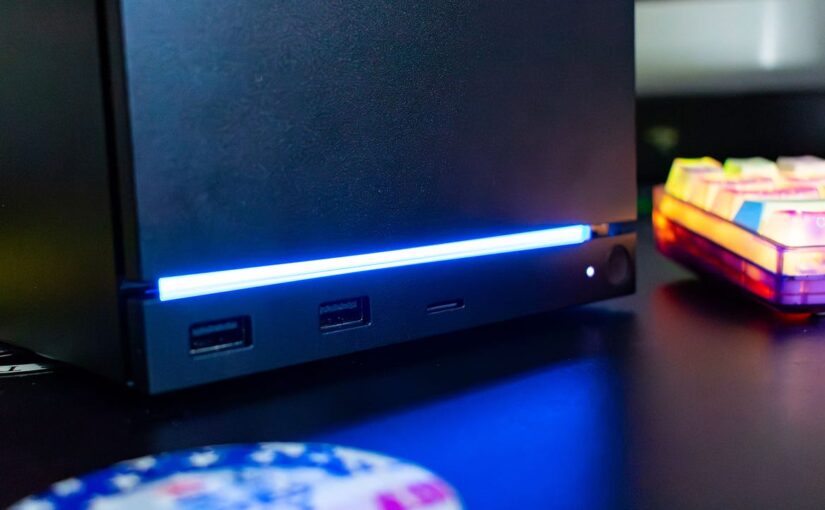


Just a couple months after Valve launched the Steam Controller, the Steam Machine has finally arrived. And while the fledgling mini-pc/console hybrid is a bit more expensive than we once thought it would be, Valve was able to still able to get it in at a somewhat reasonable price – at least for a mini PC. And, now that we’ve had a chance to test it, we were impressed by just how easy it was to use, and how well it performs in games, despite its limited hardware.
Ever since the Steam Machine was revealed in November 2025, Valve was telling us that it was just another option for folks hoping to get into PC gaming. Recently, we got a chance to sit down with Valve Engineers Pierre-Loup Griffais and Yazan Aldehayyat to discuss the Steam Machine, and how it was made. And, well, it sounds like Valve was able to achieve everything it wanted to with the Machine, except for the price. Even there, though, it sounds like Valve was able to at least mitigate the impact the RAM crisis had on the Steam Machine.
Steam Machine – Hands On Photos
IGN: The Steam Machine came in at a higher price than originally intended, but it’s still about the same price as a comparable tower PC, whereas normally mini gaming PCs have a pretty huge price jump. How did Valve keep the price from getting even higher?
Yazan Aldehayyat: I mean, I guess obviously our primary advantage is that we’re able to make a custom motherboard, custom power supply, and a custom thermal module. So that’s a huge advantage, but really it just took a lot of engineering.
We spent a lot of time optimizing thermals, working with acoustics to make sure the device is still quiet at this size and form factor. But yeah, I think this is one of the things that we’re proudest of is the form factor. It’s actually probably exceeded our expectations in terms of compactness, quietness and how cool it is while you’re using it.
But yeah, I mean, obviously, but to put it in simple terms, being able to make a custom motherboard, custom thermal module, custom power supply is the primary reason why we’re able to do this, but it’s difficult to do with off the shelf components.
IGN: Right. I guess I’m just surprised that all that engineering didn’t get baked into the cost of the Steam Machine itself. Whereas usually you’d expect having a bespoke solution like that would cause prices to skyrocket even further. I think a lot of people were braced for higher prices as well.
Aldehayyat: I mean, value engineering is a real discipline. We knew that hitting a good price point is important and we kept that in mind the whole time we were designing the Steam Machine. I mean, we could have probably made it smaller, but it would’ve been more expensive. But we just kind of picked the sweet spot for what we thought made the most sense.
So yeah, I guess I would say that good engineering doesn’t necessarily mean more expensive. And if anything, a big part of engineering is to make sure that the value still makes sense and represents the value and the cost of the product.
Pierre-Loup Griffais: When we were working on all that, of course, we were working with some parts that were a little bit cheaper to work with. But now that things like the memory and storage are more expensive comparatively than the build materials, they’re that much more expensive for the total product price.
All the choices we’ve made to aggressively limit the price and all those other dimensions shine even more because now, it’s even more competitive for the same parts that you can get off the shelf. So we’re really excited about that.
But for sure it was designed in since the beginning. There’s always a strong component of trying to make sure that we would be able to hit the most aggressive price possible.
IGN: You’ve mentioned that the hardware shortages affected availability more than price. Meanwhile, the Steam Controller sold out basically immediately, and I kind of expect the same’s going to happen with the Steam Machine. How hard would you say it’s going to be for people to actually get their hands on this thing?
Griffais: Yeah, it’s unclear. I think if you ask everyone here, you’re going to get a different answer because it would essentially be predicting what users are doing and it’s a hard problem. But I would expect, and we’ve done a little bit more work here to streamline the purchase experience. I think that we’ve shared some of the approach here with you as well and we expect that’s going to make it a little bit less stressful to try and at least get into the initial line and then later be able to purchase a unit. But it’s hard to predict to what extent people are going to have to just wait or we’ll be able to get through our launch quantities because we don’t really know what to expect out there, especially in these conditions where prices for a PC are a little bit different than when we announced.
And so folks that might have made their plans based on their original idea of what a PCU was going to be priced at might be making different decisions now. So we don’t really know what to expect, I guess is the straightforward answer.
Aldehayyat: But I also want to emphasize that even in the best of circumstances, having enough units for day one demand is always hard or basically impossible, especially for a product like this.
So, I guess I just want to point out that the biggest thing is that day one quantities, they are what they are, but we are working really hard to replenish those as fast as possible. I know that several members of the team are working around the clock to secure more supply and get more units built.
I think our FAQ definitely emphasizes the day one experience in terms of reservations and making it less stressful, because as I said before, having enough units for day one is always really hard, but things will improve over time, especially by the end of the year. And if the demand is higher than we expected, we’ll obviously do even more to build more units.
IGN: What lessons did you take from past hardware launches – the Steam Deck, the OLED version, and the Steam Controller – that you’re baking into your approach with the Steam Machine?
Griffais: Definitely the reservation system that we introduced with Steam Deck, I think, has proven to be very useful for those kinds of launches. I think users really appreciate the peace of mind of knowing that they have a place in line, and they don’t have to periodically go refresh some website or try and get in line with the anxiety that someone else might’ve gotten there before them, even though they’ve been waiting for several months.
So I think just working on the reservation system and making sure it’s good for both the waiting experience, but also the launch experience, with the addition of the randomized period and all that. Yeah, we think that’s a really important part of not making the launch experience too stressful.
IGN: I know leading up to the release of the Steam Machine, y’all were talking about 4K60 a lot, 4K60 with FSR specifically, but in my testing, I found that it’s an even better 1080p or 1440p machine. Is 4K the recommended way to go about things or is that more of a marketing point?
Pierre-Loup Griffais: Well, I think it’s broadly true that there’s a bunch of games on Steam that work really well at 4K on the machine. And even games that are still coming out, every game’s not necessarily trying to push the envelope there.
There’s games that look gorgeous that I think are still very viable at 4K Native, even without any sort of upscaling. But when you throw upscaling into the picture, especially with the upcoming FSR 4 that AMD has confirmed will be available, and that we can say confidently will be available on Steam Machine. I think it makes sense for a bunch of titles, but we also are cognizant that there’s a bunch of games where different trade-offs might make more sense. 1440P is definitely a little bit of a sweet spot. I think we anticipate that a bunch of games will end up falling probably around that envelope when you’re trying to target your best recommended settings.
But for sure 4K is not something that’s going to be possible in all titles necessarily, but I think it is a reasonable target for a lot of them.
Aldehayyat: And another thing I want to mention is that part of the 4K messaging is to some of the people who are not as familiar with tuning game settings, and might just want to get comfortable that it’s compatible with their TV, and most people have 4K TVs.
So a big part of that is just to tell people, yes, it will work with your 4K TV, you’re able to play a game at 4K and that’s kind of an important message for people who are less familiar with changing their game settings, basically.
Griffais: In general, I would also say that performance over time is a little bit of a malleable thing. We’re always working on rolling out performance improvements, and games are always rolling out post-launch updates and things to optimize performance.
But notably as part of Steam Machine development, we’ve done a ton of work on optimizing performance for low VRAM situations, optimizing performance for things like ray tracing, which we’ll be rolling out in the next few days.
We have a new driver that really improves and moves the needle on that aspect, but we’re also rolling out new technologies like FSR and different capabilities of that, like Frame Gen. All this stuff will contribute to making the performance a little bit different than it was at launch, as we roll that out. So we’re constantly working on driver optimizations and such.
IGN: I know that FSR, DLSS, XeSS, all of the upscaling solutions are a bit of a hot topic issue, especially with everybody’s different opinions on AI. How important do you think these upscaling solutions are to modern gaming?
Griffais: I think it depends on who you ask. I mean, personally, I like playing games with native AA or TAA and just cranking down resolution if I need to. But I think a bunch of people are clearly okay with upscaling, and that technology has evolved a bunch over the years, where some of the artifacts that you would use to see are not really represented that much.
So I would say it seems like a technology that’s pretty popular right now. So it was important to us that we could work with AMD and make sure that the latest version of FSR upscaling is going to be supported on Steam Machine. And so we’re pretty excited that they’re bringing that over ,because there’s a bunch of games out there that support FSR 4 that will benefit from it.
IGN: FSR 4 was built for RDNA 4 rather than the RDNA 3 GPU that’s built into the Steam Machine. How much of a performance impact is that going to have, with having fewer of the AI processors on your GPU?
Griffais: I mean, given that it’s not released yet, I don’t really know for sure. I guess maybe that’s a question for AMD to some extent. But I think we’ll be able to see as soon as the FSR 4 support is released, of course there’s going to be a lot of comparisons as to what the performance hit is and so on.
My understanding, and again, I don’t want to speak for them. I think it’s an AMD question at the end of the day, but my understanding is that they kind of tuned the FSR technology to be performing well on RDNA3, so I would expect to see good results there.
IGN: The Steam Machine’s tuned for a specific performance target, but I think there are a lot of people that might want a more performant option. Is the approach with the future iterations going to be the same as the Steam Deck where you’re waiting for a really big generational leap or is there a possibility of a Steam Machine Pro somewhere down the line?
Aldehayyat: I mean, we don’t have anything to announce or any concrete plans either way. I mean, obviously we will react to people’s demands and requests and evaluate what the market is doing and what technologies are available, but yeah, we don’t have anything to say about that.
Griffais: Yeah. I think that because Machine slots more naturally in the PC ecosystem in terms of having more direct analogues there, you can build a PC yourself that’s pretty much the exact same performance target.
Because of that, I don’t see it as having the same, I guess, requirements as something like Steam Deck when it comes to having the performance target be stable over time. So I think that it’s maybe a little bit more linear, and not as much of a discrete jump every few years or something where you might imagine more gradual performance bumps.
That being said, I think the main way that people will experience those performance improvements will be by building their own equivalent to it. There’s a lot of different PC parts that you can use that work great with SteamOS now and we’re really excited that people can build something like the Steam Machine, but they might decide to make different trade-offs when it comes to maybe they need more CPU, maybe they need more GPU, maybe they want more memory or whatever they think that is going to be a better performance target for them.
They can build that and put SteamOS on it and they’ll pretty much have the same experience. There’s some things that are hard to build when you’re doing your own custom PC, of course: The form factor, the noise level, the fact that we have a dedicated Bluetooth antenna for controllers, that we have CEC support, all that is a little bit harder when we’re doing your own PC or even impossible in some cases.
But the SteamOS work that powers that experience will be, and to a large extent, is already available to everyone that wants to put together a similar kind of envelope at different levels of performance.
IGN: How were you targeting the dichotomy between building a gaming device versus building a PC?
Griffais: We’ve been very cognizant of that plurality of different use cases and opinions in the PC landscape ever since the initial design phase there. It was important to us that it could be used as a desktop, including having the DisplayPort output and having the two simultaneous display outputs.
I think with all these features and the way that we’ve laid out the ports and all that, there’s definitely some thought put behind the fact that someone might elect to put it on their desk and do something different with it than just a docked Steam deck type of experience.
And so yeah, we’ve been aware of that. Whether one or the other is the priority is a little hard to say because we’re trying to make sure that it’s a great experience for both, but for sure I would say right now the gaming side of the experience is more developed because of where we come from.
I think the whole desktop aspect is something that we want to … We’ve been improving, we’ve been working on it, but we want to keep working on going forward as well.
Aldehayyat: I mean, I don’t think it’s a coincidence that a good PC is also a good gaming device. At the end of the day, good hardware is good hardware. So in a lot of ways, the challenges you’re trying to solve are, a lot of them are pretty much the same.
Everybody prefers smaller, quieter machines, regardless whether they’re to do productivity or to do gaming on them. So yeah, I think it’s just kind of born out of the desire to make a good device in general effectively.
IGN: One of the things I noticed is that it’s kind of difficult to tear into the thing. What was the mindset behind making it a little bit harder to open versus just being able to just slide open a panel and pop in an SSD?
Griffais: I think that part of what you’re seeing there is less about making it harder to open and more about the constraints of working in a form factor like that. So I think if anything, we’ve probably erred on the side of it being easier to open than it might be if you had designed a system with that sort of form factor, without also being cognizant of the fact that people are going to open it and need to access the SSD.
So I think it’s not as easy as a big case type PC where you can have a panel that opens and gets to everything, but we’re still, I guess we’re pretty happy with where we ended up there because there’s a bunch of trade-offs we could have made that ended up in the opposite direction where it’s even harder than what you’re experiencing now.
Aldehayyat: Yeah. I mean, I just want to say that we actually tried really hard to make it as repairable and openable as possible, but the side effect of making something compact is that it’s harder to get into. The smaller something is, that’s just the less options you have for adding panels and compartments and all that kind of stuff.
Like for example, the SSD being on the FPC that loops around the power supply and being around to the bottom of the power supply, that was not because it was the easiest way to do it. We could have just buried it inside the thermal module, for example. We actually made the conscious decision to do that simply to make it easier to get to the SSD.
And we actually wanted to do that with memory too, but it’s just from a signal integrity standpoint, which just wasn’t possible. So yeah, to say that we actually tried really hard to make it as repairable as possible, but still being compact is what made it difficult. It was difficult to achieve something that’s really compact and still make it as easy to fix as possible.
IGN: Will Valve be selling faceplates for the Steam Machine beyond the ones that come bundled with the 2TB model?
Griffais: Right now the faceplates that are included with the 2TB models are what we’re doing faceplates-wise. We’re also releasing the CAD for the external hull of the machine and the spec around the attachment points for the magnets for the face plate and all that so that people will be able to make their own, and third parties will be able to make their own as well.
We don’t really have any collaborations firmly planned or anything to announce on that front. So I guess the short answer is we don’t really know right now, and the two faceplates that you get with the 2TB model is it.
Steam Deck OLED – Photos
IGN: The Steam Deck is still one of the most popular handheld PCs. I know it’s a little more expensive now, but new chips for handhelds are right around the corner with Intel’s Arc G processors that were announced at Computex. How close are we to that “next generation” that would at least in theory prompt a sequel device?
Griffais: I’d say we’re closer than we were the last time we talked and so on. We’re definitely getting there. I would say that the new chips that are coming out are still in power envelopes that are not quite the right segment that you’d want for a true handheld experience.
I think a lot of them are more low-end laptop chips or playing in that sort of form factor that are then repurposed for handhelds and maybe not leading to, I guess the trade-off that we would’ve chosen in terms of power and better life and that and all that.
But we’re working towards our next gen for sure. And yeah, we’ll definitely be talking about that in the coming years, but right now we’re focusing on Machine.
IGN: Yeah. Honestly, I think one of the best things about it is how good it is for beginners. I was impressed by just how easy it was to just get in there and just start downloading games rather than having to download a bunch of drivers or change up settings and all the other stuff that you have to do when you buy a new Windows PC, for instance.
Griffais: For sure. That definitely was a goal … I mean, we got that feedback a lot with Steam Deck docked, and we were trying to get to the point where you can expect the same sort of plug and play.
I mean, the mission statement for SteamOS is to get out of the way so you can get in and out of your games. And that was the case with Steam Deck. We’re trying to apply that to Steam Machine as well.
IGN: How do you feel about people making third party integrations into the Steam Big Picture app to get things like the Heroic Game launcher or BattleNet running on SteamOS?
Aldehayyat: I mean, in general, being able to install whatever software you want without having to consult with us is a big goal of this, to represent that aspect of PC. So I think it’s great that folks are finding ways to streamline that as well. But in general, I think if you need some kind of third party component to be able to load your apps, we suspect that there’s something we could be doing better, just so that that’s possible out of the box without needing that kind of software.
So it’s something that we’re working towards to try and improve, but I mean, the power of PC is that in the meantime, those community projects can get the job done for folks that find them and want to use them. So I think it’s really a celebration of what everything that PC Gaming stands for, that people are able to do that and that we’re not really in the way of that. So we’re pretty excited by that in general.
IGN: One of my favorite things about the Full Screen Experience on Windows-based handhelds is the smattering of different launchers that you can just immediately integrate into the UI. Is that something like what you’re talking about?
Griffais: I don’t know that we would necessarily pick and choose and bless certain things to be pre-installed or pre-represented in a way that’s easy to install, but our assumption is definitely that if you can download an installer or some kind of application on your normal PC, double click on it and get what you expect, which is the thing is installed and you can get at it later. We want to get to the same point for SteamOS where you don’t have to have an installer, like an extra thing or you don’t have to feel like you’re going under the hood to do that.
The whole concept of side loading is kind of antithetical to what we’re trying to do. It’s just installing apps on your system. There’s no concept that some applications are more native than others or anything like that. If there’s something that works on PC, it should be able to work here and we’re trying to get closer to that experience where you can just install whatever application and have it react the way that you’d expect without having to do anything custom.
Jackie Thomas is the Hardware and Buying Guides Editor at IGN and the PC components queen. You can follow her @Jackiecobra